
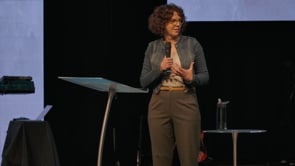
Christy McHugh — In our last week of this series, Christy takes a look at the metaphor of the Jewish wedding. There are two stages of Jewish weddings - with a long waiting period in between. The parallels in this metaphor point to the work and the cost are the responsibility of the bridegroom.
Yet, we know in the paradoxes of the Kingdom of God, this does not mean we have no cost to pay. Nor do we have no work to do. There is a dear cost to pay and there are works to do. The tension becomes what order we live from. Do we live in response to his love or do we work to earn his love? As the bride of Christ, we can not get this order wrong. We have to know we are loved and only operate in response to his love.
Resources—Study Guide
Anna Joyce — What does it look like to be a Bride who hungers, a Bride who releases love and beauty, and a Bride who waits?
God wants to release something new, something beautiful and something powerful in the world. There’s something stirring in our hearts, a passion for the lost, a longing for beauty and a deepening hunger for more.
Anna Joyce — What does it look like to be a Bride who hungers, a Bride who releases love and beauty, and a Bride who waits?
God wants to release something new, something beautiful and something powerful in the world. There’s something stirring in our hearts, a passion for the lost, a longing for beauty and a deepening hunger for more.
How do we partner with what God is doing? By keeping our lamps burning with hunger and passion for Him. By dwelling with Him in deep intimacy and surrender.
By being a people of love. Committed to releasing beauty into the world by the way we love God, love ourselves and love each other.
By being a people committed to waiting on the Lord for His direction and leading. A people of prayer who deeply believe in the supernatural as the real, true reality and not the one around us that we can see and touch.
Resources—Study Guide
Dave McHugh — In this week’s message, Dave calls us back to the foundational truth of our identity: we are God’s beloved. We are to recognise the reality that the beauty and radiance of the Bride of Christ is founded on the unshakable knowledge that we are unconditionally loved and chosen.
With our identity as His Beloved as our foundation, there are two postures we are called to embody in this season that enable us to walk in authority as His bride: humility and joy.
Resources—Study Guide
Peter McHugh — As followers of Jesus, we are called to war. Not war against people, but a spiritual war against the forces of darkness that attempt to come against the people of GOD establishing the Kingdom of GOD on the earth. Battles are meant to be expected, therefore fighting together as a community with the truth of the Word of GOD is important for us to understand.
Resources—Study Guide
Sarah Hudson — This message is a wake-up call to a Church that has inadvertently elevated platform over presence and performance over intimacy. Rooted in the imagery of God as the jealous Bridegroom, it reveals His holy, burning love—a divine jealousy that passionately pursues the hearts of His people.
In Ezekiel 16, we see a God who rescues, adorns, and elevates His Bride, only for her to place trust in her own beauty and fame, turning His gifts into idols. As 2 Corinthians 11 warns, this misplaced trust can open the door to a different gospel and a different spirit—something Paul urgently confronts. Today, the same pattern is seen in our obsession with visibility, productivity, personal calling, and spiritual branding. We’ve confused platform with spiritual authority, influence with fruitfulness, and success with divine favour. Yet God is lovingly shaking what we’ve built—not to condemn us, but to draw us back to Himself.
This is not a message of shame, but a call to return to our first love. The Bridegroom is near, and He is seeking a people prepared for Him—not through performance, but through deep, surrendered devotion.
Resources—Study Guide
Nartarsha Wisewould — This week Nartarsha explores the church, as the bride of Christ, preparing herself for His return. We are to keep our lamps burning— staying full of the Holy Spirit, remaining faithful to Jesus, and ready to shine His light to the world so that others may hear the invitation to 'come'.
Resources—Study Guide
Matt Romano — This message explores the story of Mary and Martha through the lens of Revelation 22:17—“The Spirit and the Bride say, ‘Come.’” It invites us to see that God is forming a Church not through productivity but through proximity.
Matt Romano — This message explores the story of Mary and Martha through the lens of Revelation 22:17—“The Spirit and the Bride say, ‘Come.’” It invites us to see that God is forming a Church not through productivity but through proximity. In a world of distraction, busyness, and performance, Jesus calls His Bride back to the “one thing necessary”: intimacy with Him. Like Mary, we are invited to sit, listen, and receive. Like Martha, we are challenged to release anxiety and come back to presence. This is not just about a moment—it’s about becoming a people who embody a bridal love, responding to the Spirit’s call to communion.
Resources—Study Guide
Andrew Gilbert — GOD is inviting us into deeper levels of knowing Him. This requires us to see ourselves not as a busy Church, but as a present bride. The Ekklesia or called out ones, are called by name towards our Metaphorical Husband, Jesus.
Andrew Gilbert — GOD is inviting us into deeper levels of knowing Him. This requires us to see ourselves not as a busy Church, but as a present bride. The Ekklesia or called out ones, are called by name towards our Metaphorical Husband, Jesus. The ever-deepening waters of intimacy are an invitation to know Him more - He calls us into the depths of knowing Him more. This is a cry for intimacy - or ‘into-me-you-see’ - towards us, from Him, to know Him deeper, and He to know us deeper too. This is reflected in Revelation 22:17 ’’The Spirit and the bride say, “Come!”’.
Resources — Study Guide
Sarah Hudson — What does it really mean to be the Church - not just attend one? This message explores the deep identity of the Church through the lens of Scripture's most intimate metaphor: The Bride.
Sarah Hudson — What does it really mean to be the Church - not just attend one? This message explores the deep identity of the Church through the lens of Scripture's most intimate metaphor: The Bride. Drawing from both Old and New Testaments and culminating at Revelation’s vision of a restored creation, we are invited to rediscover the Church not as a building or event, but as the beloved of Christ - called out, longed for and destined for union. It’s a call to awaken our deepest desires and embrace God’s desire for us. This isn’t about doing more - it’s about being known, loved and transformed.
Resources — Study Guide
Spirit + Bride
Dallas Willard suggests that "we live at the mercy of our ideas." As followers of Jesus, have we stopped to ask ourselves—what does it really mean to be the Church? Are we living as the people God has called us to be, or have we settled for a diluted version? Do we truly understand who we are and whose we are?
John G. Stackhouse says, "When we, the church, are confused about who we are and whose we are, we can become anything and anyone's… When the church is confused about who it is and whose it is, it can become just another institution, just another collective, just another voluntary society. So we need ecclesiology—the doctrine of the church—to clarify our minds, motivate our hearts, and direct our hands. We need ecclesiology so that we can be who and whose we truly are."
Throughout Scripture, the Greek word for church is ecclesia—the called-out people of God. The church was birthed on the day of Pentecost, marking the explosive beginning of a new era. Acts 2 records the day of Pentecost, where the Holy Spirit descended on 120 believers gathered in an upper room. Suddenly, what Jesus promised in John 14 became reality—the Spirit would come, dwell in them, and empower them to be His witnesses “to the ends of the earth.” The church was not born to exist as an institution, but as a Spirit-empowered movement set apart for mission.
From the beginning, Christ has been calling a Bride to Himself—a people set apart and prepared for a holy union. Revelation gives us a powerful vision of what’s to come—the Church, as the Bride, finally united with Jesus, the Groom, attending the wedding supper of the Lamb. It’s not just about reaching heaven—it’s about being formed into the image of Christ along the way.
Right now, we’re in a process of preparation, being shaped into who God created us to be. This is a process directed by and empowered by Holy Spirit, but it isn't a passive process; it’s about actively becoming more like Jesus—in our character, our actions, and our love for others. The Church is more than just going through the motions—we are being formed for glory, shaped to reflect Christ’s love and purpose. May we, as the Bride, empowered by Holy Spirit, know who we are and whose we are as we continue to prepare for the Groom.
This series will explore what it means to be the church, the current cultural challenges facing the church, and the vision for the church.
Dave McHugh — Today Dave shares from his heart around the big idea of building legacy and what it looks likes for us as a collective community to build legacy together. He shares to inspire us to be intentional about the legacy we are building and leaving for those coming after us.